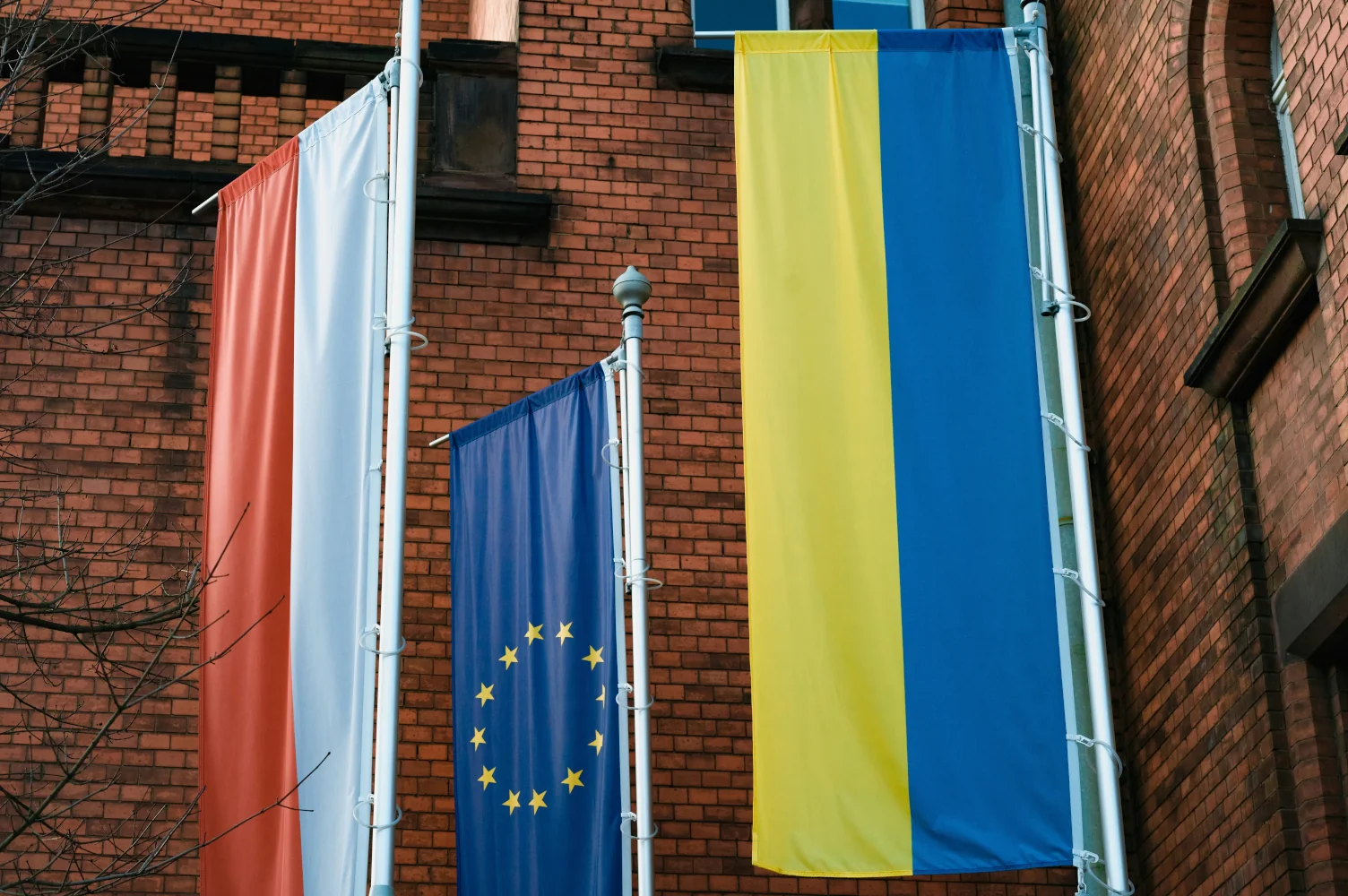


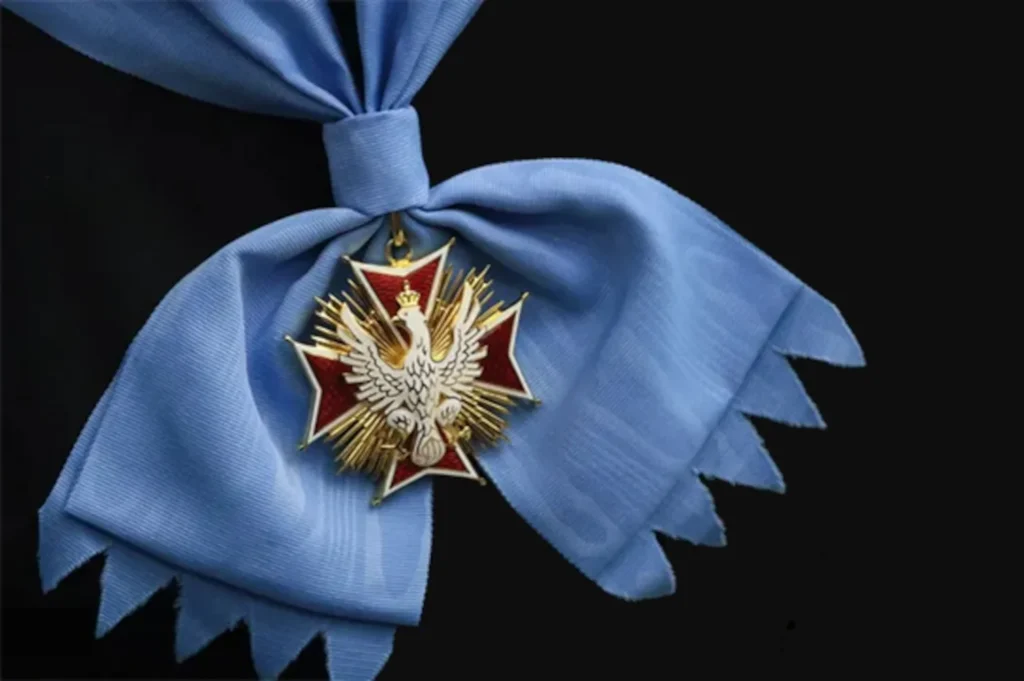
A scandal is raging in the Polish internet over Ukrainian President Volodymyr Zelenskyy’s decision to grant the honorary title “Heroes of the UPA” to the Separate Center for Special Operations “North”. Karol Nawrocki’s reaction – demanding that Zelenskyy’s Order of the White Eagle be revoked – is somewhat amusing, considering that Gerhard Schröder, a fan of kremlin caviar, remains a recipient of this order, writes Ukrainian writer and journalist Yuriy Vynnychuk for zbruc.eu.
If you are to be consistent, you should also revoke this order from Viktor Yushchenko, who awarded the title Hero of Ukraine to Stepan Bandera. But why stop there? What about Benito Mussolini? Or Miklós Horthy, another Hitler ally? Or Philippe Pétain, the collaborator? Or Erich Raeder, Commander-in-Chief of the Nazi Navy, who was sentenced to life imprisonment at Nuremberg?
Do they – from a modern perspective – deserve these orders?
Poles have long reacted nervously to the red-and-black flag, considering it a Bandera symbol, though it is also a Cossack flag, as seen in Ripyn’s paintings. It’s like the swastika: even though it dates back to ancient times, the Nazis tarnished it, so now it’s banned.
Is the Order of the White Eagle pure and untarnished? No, because after Poland was annexed by the russian Empire, the order remained in its award system. It was given to russian landowners, politicians, and even generals who suppressed Polish uprisings. For example, Mikhail Muravyov, the “Hanger”, who crushed the January Uprising of 1863–1864, was awarded this order.
In 1898, a monument to Muravyov was erected in Vilnius. After Poland declared its independence, the Polish authorities demolished it and built public toilets in its place.
Yet the order itself was never revoked. Oh well!
Judging by the reactions of ordinary Poles, one might think that half of Ukraine’s military units are named after the “Heroes of the UPA”, and that Bandera monuments stand in almost every city. In reality, none of the five largest Ukrainian cities have such monuments. They are all concentrated in Galicia. The same goes for streets named after Bandera – 90% are in Galicia.
The internet is full of incredible nonsense: “Ukrainians murdered a million Poles!” When someone points out that there weren’t even that many Poles in Volhynia, the response is often: “Because the census didn’t count children.” Then come even more absurd claims: “Kuchma admitted to 600,000”, “Leonid Kravchuk spoke of 500,000 – and since children weren’t counted, so it should be times X.” They’ve even invented a “hellish slogan” attributed to Bandera, who allegedly believed Ukraine should be “as pure as a glass of water.” Shukhevych is accused of planning ethnic cleansing against Poles, and Volhynia is described as “a genocide far worse than Auschwitz!”
And, of course, demands are already being made: “Close the border!”, “Shut down the airport in Jasionka!” (near Rzeszów). This falls into the category of “cutting off your nose to spite your face” – because Rzeszów has prospered immensely from the constant transit of Western aid.
The most amusing idea I’ve heard is: “We should have taken our part of Ukraine, as the russians suggested.”
Let’s check a Polish encyclopedia from 1932. The Volhynian Voivodeship had 1,569,559 inhabitants in 1921, of whom 16.8% were Poles, but only 11.6% were Roman Catholics, while 68.4% were Ruthenians (Ukrainians), 10.6% Jews, 1.7% Germans, and 1.8% Czechs. (Though 74.2% were Orthodox, so this also included “locals” and russians fleeing the Bolsheviks.)
By 1931, the population grew to 2,081,501, with:
- Orthodox: 1,455,882 (69.8%)
- Roman Catholics: 327,856 (15.7%)
- Jews: 207,792 (10%)
- Protestants: 53,400 (2.6%)
- Greek Catholics: 11,137 (0.5%)
The 1931 census was the last in pre-war Poland. By 1939, the percentages hadn’t changed much – even though thousands of veterans settled in Volhynia, the Ukrainian population still dominated.
Modern Poles don’t want to hear what was really happening in Volhynia – the total Polonization that took place. In 1925, there were 500 Ukrainian schools in the region; ten years later, only four remained. A third of school-aged children received no education at all, leading to mass illiteracy. In 1931, 47.8% of Volhynia’s population was illiterate.
My grandmother and her sister from the village of Mali Filvarky near Kremenets were illiterate. My mother, however, graduated from a Polish school where Ukrainian was not taught.
And let’s not forget the forced conversions of Orthodox Christians to Catholicism, carried out brutally by the Border Protection Corps. A major scandal erupted in the village of Hrynky near Kremenets, where almost the entire population was tricked into converting to Roman Catholicism. The case was even discussed in the Sejm (Polish Parliament), and even Polish newspapers condemned the operation. Polish writer Maria Dąbrowska was outraged at the time, calling it “an army acting as Polish crusaders, converting the Orthodox to Catholicism. Morally – disgusting. Politically – clinical madness, a sin for which Poland will pay dearly.”
Her words, unfortunately, proved prophetic.
Now, our government wants to somehow wiggle out of this uncomfortable situation that has so upset the Poles. But if we revoke the “Heroes of the UPA” title, it would look stupid and cowardly.
There is, however, an alternative.
After all, there were three UPA factions. Two of them – Bulba-Borovets’* and Melnyk’s – had nothing to do with the Volhynia massacres. In fact, they suffered at the hands of the Bandera faction, which executed several of Melnyk’s officers who refused to join them – including Andriy Yavorenko, in whose unit my father fought. And my father disliked the Bandera faction just as much as the Poles did. So there you have it.
My father refused to join them, surrendered his weapons, and to avoid being taken to the Reich by the Nazis, enrolled in an agronomic school.
The hatred between the Melnyk and Bandera factions was so deep that they were even buried apart in cemeteries. As for Bandera himself, he can’t be blamed for the Volhynia events – he didn’t participate in them and didn’t order the disarmament of Bulba-Borovets’ or Melnyk’s forces, as he was imprisoned in a concentration camp at the time. The Poles, after all, murdered his two brothers, so one could say the score is settled.
Thus, by clarifying which UPA we’re talking about, we could resolve the scandal. Alternatively, we could take another approach: list all Polish military units named after AK [Armia Krajowa / Home Army – UT] detachments and demand symmetrical actions. And, of course, return the Order of the White Eagle, refusing to share this honor with fascists like Mussolini and Nazis like Raeder.
Or we could do nothing, because it wouldn’t help anyway. The hate train has already gained speed, and there’s no stopping it.
* In 1945, Taras Bulba-Borovets was detained in the British occupation zone on charges of committing crimes against the Polish civilian population. However, the investigation established that the units under his command did not participate in such actions.