




In August, the German government updated its cumulative support for Ukraine as of June 30, 2026, at EUR 100 billion: EUR 43.3 billion in civilian and EUR 57.6 billion in military support, reported as “provided or earmarked for the coming years.” The figure quickly entered the media and political debate but was rarely explained or decomposed, the Kiel Institute reported.
At the same time, German support has become increasingly difficult to track: Since June 2025, the German government has no longer published detailed information on military aid, the most important component of its bilateral support. While details are missing, the aggregate reported numbers continue to be published, making it even more important to understand what is behind them.
Most civilian aid to Ukraine is spent in Germany
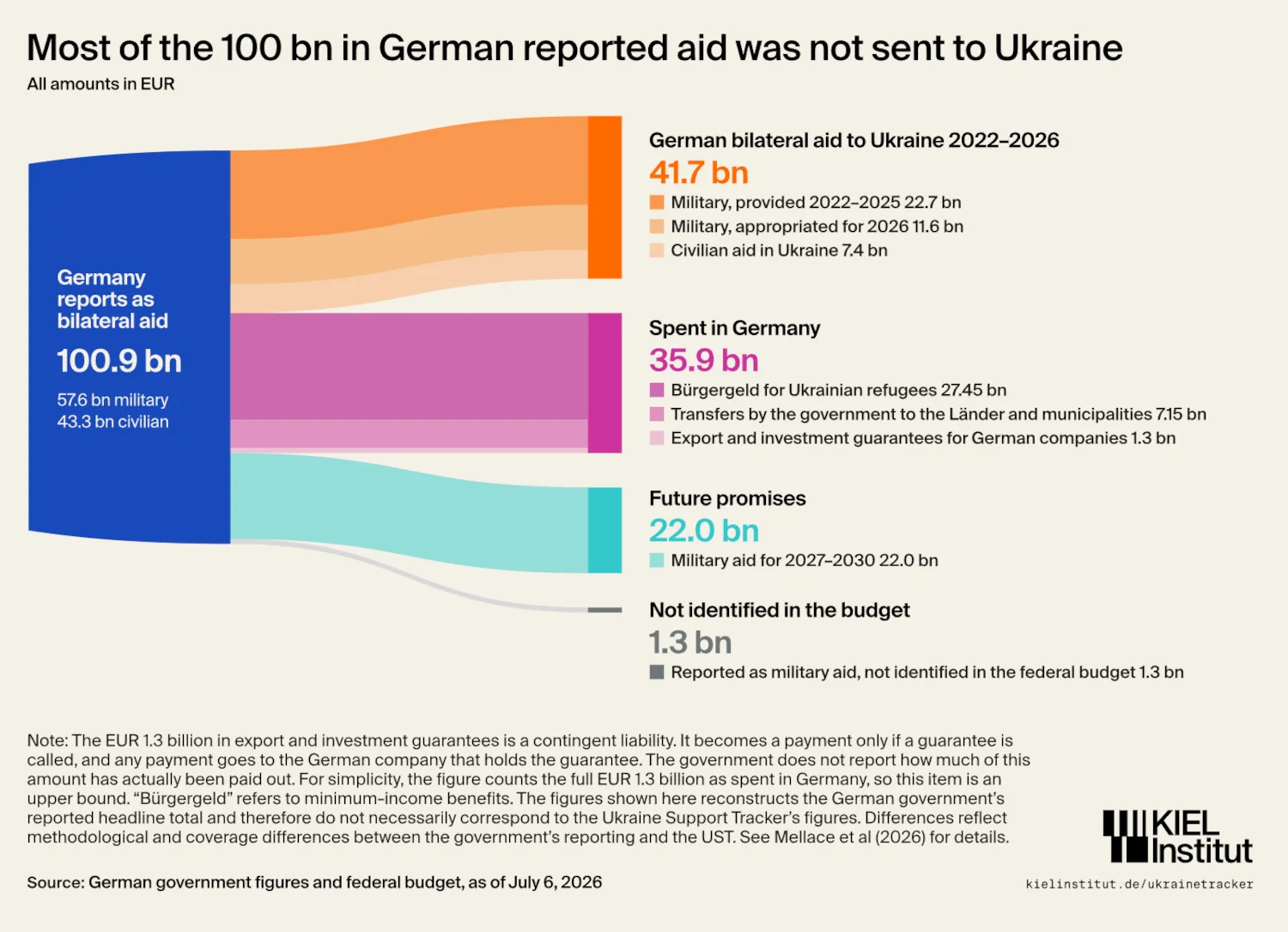
A closer look shows that of the reported EUR 43.3 billion in civilian aid, EUR 35.9 billion, or around 80 percent, was spent in Germany. Around EUR 27.45 billion was used to support Ukrainian refugees residing in Germany (Bürgergeld benefits), while EUR 7.15 billion was given by the government to the states and municipalities for refugee accommodation. The remaining part of the EUR 35.9 bn are EUR 1.3 billion of export and investment guarantees for German companies operating in Ukraine.
Only EUR 7.4 billion actually went to Ukraine: EUR 6.3 billion for humanitarian aid, emergency energy support and the reconstruction of Ukrainian government agencies, EUR 1 billion as a grant to an International Monetary Fund-administered account for the Ukrainian state, and EUR 0.1 billion in debt relief through a temporary debt-service moratorium.
“Most of what the German government counts as civilian support ‘for’ Ukraine is actually spent in Germany – on Ukrainians living here,” says Christoph Trebesch, head of the Ukraine Support Tracker. “This money does not support the Ukrainian government in defending itself against russian attacks. After all, we would not call social spending on Syrian refugees ‘bilateral aid to Syria’ either.”
Military aid to Ukraine is lower than originally reported
The German government reports EUR 57.6 billion in military aid. According to the federal budget, Germany provided around EUR 22.7 billion in military aid between 2022 and 2025, while another EUR 11.6 billion was appropriated for the fiscal year 2026. How much of this has already been disbursed is unknown. Another EUR 22 billion consists of future promises: EUR 10.1 billion is binding commitments, while EUR 12 billion is potential additional expenditures in the form of commitment authorizations. This brings the traceable total of military aid to EUR 56.3 billion, EUR 1.3 billion less than the figure reported by the German government; which however does not offer any suggestion on how this figure should be decomposed. Further details regarding the figure breakdown can be found in the new Kiel Policy Brief: “How much aid has Germany given to Ukraine?”
EUR 100 billion is misleading
Overall, the reported EUR 100 billion can only partly be classified as “bilateral aid to Ukraine.” Only 40 percent, or around EUR 41.7 billion, actually went to Ukraine. EUR 35.9 billion was spent in Germany, while another EUR 22.0 billion consists of future promises whose implementation remains open.
“Germany is clearly Europe’s biggest donor to Ukraine. But the German government’s communication about its aid is becoming increasingly confusing,” says Trebesch. “The EUR 100 billion figure is misleading and wrongly labeled as ‘bilateral aid to Ukraine’. This is unfortunate, given how much Germany is doing.”