
|
Getting your Trinity Audio player ready... |


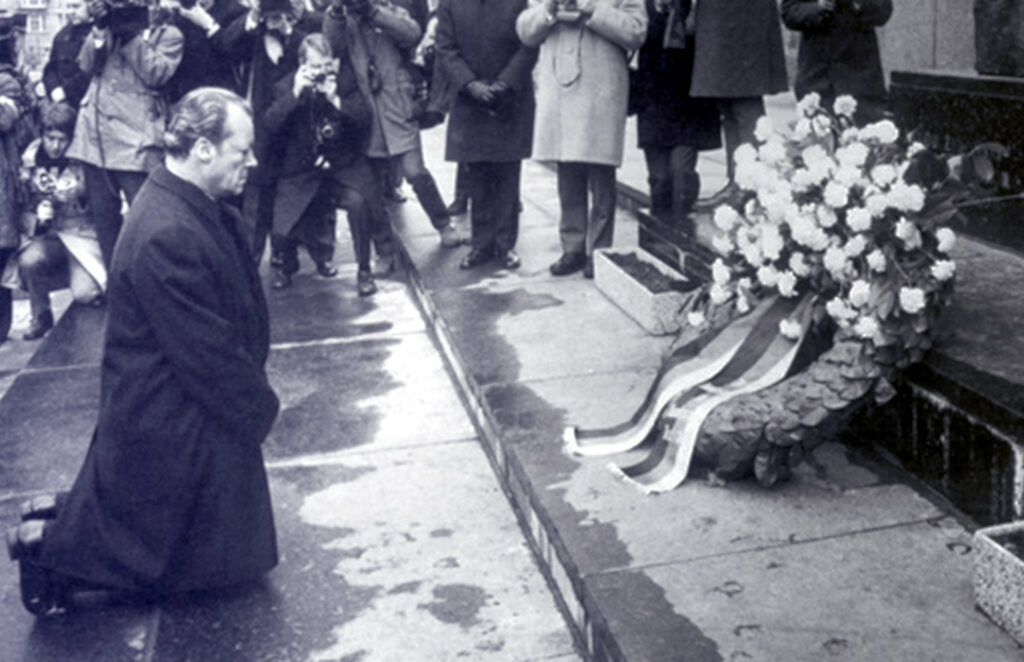
Fifty-five years ago, in December 1970, German Chancellor Willy Brandt knelt before the monument to the victims of the Warsaw Ghetto Uprising during his visit to Poland, writes Ukrainian journalist Vitaly Portnikov for zbruc.eu.

It was a shocking gesture that literally no one was prepared for—neither the guests nor the hosts. Until then, no politician in the world had ever allowed himself such open repentance—at least in recent history. German society was almost split in half over Brandt’s gesture, but still the majority did not support the federal chancellor’s action. However, two years later, the Social Democrats led by Brandt confidently won the parliamentary elections. The German people ultimately recognized that with his unexpected decision, the chancellor, who was a staunch anti-fascist and returned to Germany in the uniform of the Norwegian army after Hitler’s defeat, had saved the honor of the German people.
A lesser-known part of that visit was the signing by Brandt and Polish Prime Minister Józef Cyrankiewicz of an agreement recognizing Poland’s new borders established after World War II. Brandt became the first post-war chancellor of the new Germany to renounce revanchism and nostalgia for lost territories—although, unlike the Ukrainian territories claimed by russia today, these lands were, in fact, inhabited by Germans before World War II. But Brandt believed that future good neighborliness was more important than historical nostalgia. And this was despite the fact that at the time of his agreements with the Poles, there was no common border between West Germany and Poland: it only appeared after the German Democratic Republic disappeared from the political map of the world. So, it can be said that Brandt’s agreement was a document that was essential not only for Poles but also for future German unity, even if no one could have dreamed of it at the time.
For me personally, Brandt’s act became a kind of “gateway to Germany”—both as a country and as a civilization. I belong to a destroyed people. My grandmothers still shuddered when they heard the German language—which is not surprising for people who lost their parents and relatives in the ravines of Ukraine during the Holocaust. But Brandt’s courageous decision convinced me—when I found out about it, of course—that there have always been Germans who were ashamed and ready to fight evil. Moreover, repentance for evil is possible in Germany at the state level and not just in a conversation with a casual acquaintance.
But today, I think first and foremost about whether Brandt’s actions could be repeated in the russian-Ukrainian war. Will we ever see a russian president capable of kneeling in Bucha?
I have serious doubts. russian social and political culture does not recognize either defeat or apologies. Brandt understood perfectly well that his gesture was a consequence not only of Germany’s political defeat but also of its moral defeat and the crimes that were part of that defeat. russians do not notice their defeats. It is not that they do not exist, but the state, society, education, and historical science confidently ignore them. And if there is no sense of defeat, there is no remorse: why should the eternal victor apologize?
In addition, the cult of “good evil” is also part of this culture. Ivan the Terrible turned the Muscovite state into a degenerate den of repression, but he is still perceived as one of the greatest monarchs. The same goes for the paranoid Peter I, who buried hundreds of thousands of people in the swamps of St. Petersburg, and, of course, Stalin. The attitude towards Stalin is a kind of incredible Stockholm syndrome. A man who sent tens of millions of russians (and non-russians, of course, but we are talking about russians now) to their deaths still inspires admiration. And don’t say that it’s all putin’s propaganda. Even in Soviet times, when the authorities restricted this admiration, “ordinary people” could tell you in private how wonderful it was under the leader.
People who tolerate evil directed against themselves cannot understand the need to apologize for the evil done to others. That is why the Holodomor happened—but they will tell you that there was famine everywhere! That is why Crimea was seized—but they will tell you it is russian, and the Crimean Tatars are traitors. That is why there was a full-scale invasion—but they will tell you that the Minsk agreements had to be implemented. That’s why they say that Bucha was staged. It is worth remembering that this is precisely how russia talked about Katyn for decades, blaming the Germans for Stalin’s decision to kill Polish officers—and now they are quietly returning to this version.
russians do not apologize. Because only weaklings and losers apologize. They did not apologize for any of the civilian aircraft they destroyed—even when it was necessary to break the deadlock in relations with Azerbaijan. It was in putin’s interest to apologize, but he did not give in here either.
So no, we will not see a russian president who is willing to kneel in Bucha. In authoritarian russia, such a president would simply not consider it possible to “bow down,” and in a democratic russia, such a president would simply never be elected. The problem is not putin, but the society that created him.
And then it’s up to the Ukrainians. After the war—whenever it ends—we can either coexist alongside a country that stubbornly refuses to see the horrific crimes committed against the Ukrainian people, and even takes pride in these crimes and romanticizes them “like Afghanistan.” Or we can finally cut ourselves off from this country and realize that any reconciliation is only possible after reparations and repentance—and even then, not immediately.
I have almost no doubt that most Ukrainians will choose the first option. But I would still recommend the second.