|
Getting your Trinity Audio player ready... |


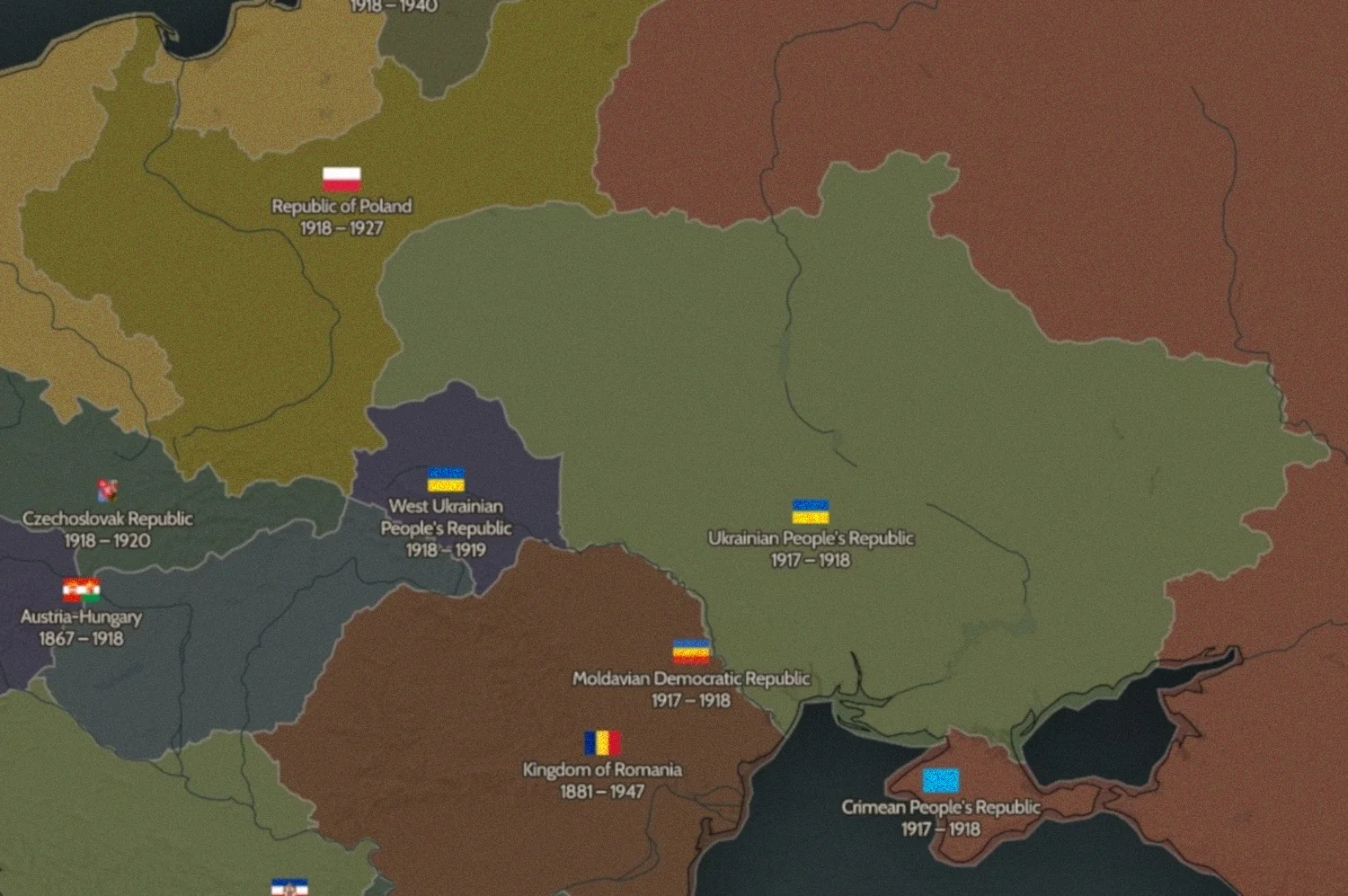
The current Polish political leadership is more comfortable with the pattern of victimhood: “Poland has never occupied Ukraine.” But this way of thinking breaks all links between causes and consequences of events of the interwar twenty years. Poland won its independence at the expense of Ukraine’s independence. The time has come to say this out loud, emphasizes historian and publicist Oleksandr Zinchenko in his article published on istpravda.com.ua.

On October 17, 2017, the Polish Ministry of Foreign Affairs issued an official statement: “Poland has never occupied Ukraine. Some territories of today’s Ukrainian state were part of the Republic of Poland on the basis of international law.”
Over the year that has passed, Polish diplomacy has not found the strength to invalidate this statement and bring its position into line with the historical facts that took place in the past.
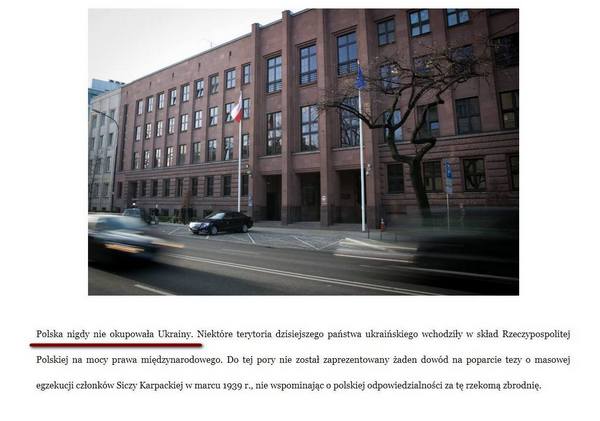
A little over a week ago, a discussion appeared in the Polish media between journalist Maria Pyzh and the head of the Institute of National Remembrance of Poland, Jarosław Szarek. The publication came out with the headline—“There was never Polish occupation in Lviv; it was the Independent Second Polish Republic.”
Then follows a direct quote from Jarosław Szarek:
“This was not a Polish occupation. This was an Independent Republic. The Republic was home not only for Poles, but also for Ukrainians, Jews, and Belarusians. (…) The occupation was German and Soviet, but there was never a Polish occupation in Lviv.”
It is very bad when politicians ignore facts known from historical sources.
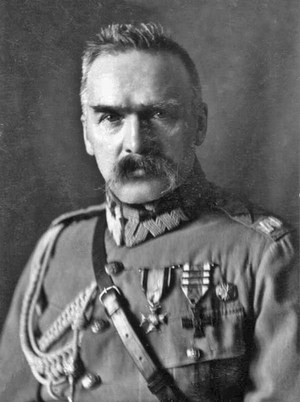
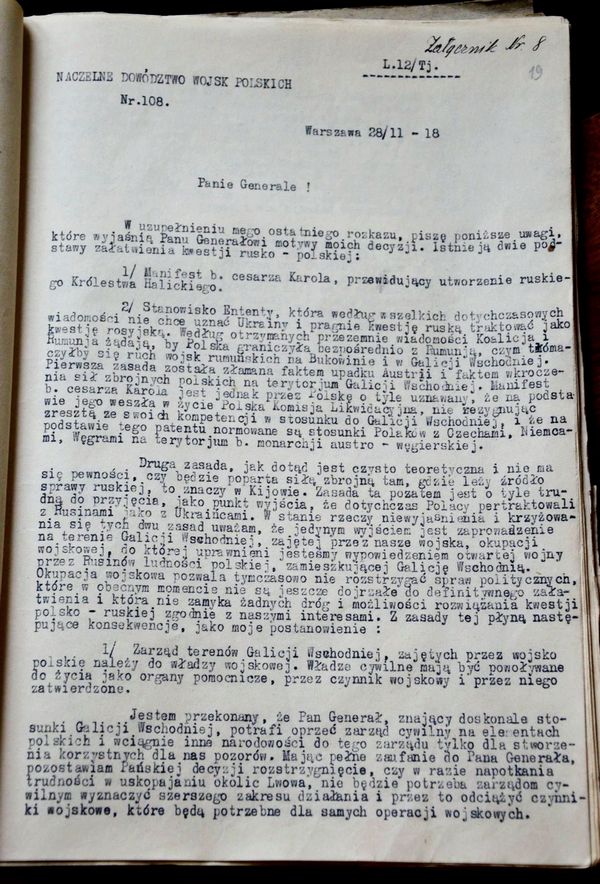
On the 17th day of Polish independence—November 28, 1918—the acting head of the Polish state, Józef Piłsudski, explains in instructions to his general Tadeusz Rozwadowski the political grounds for his order to occupy Ukrainian lands in Galicia and Volhynia.
This document is well known to Polish historians, although it has never been published by Poland in full. In the State Archives of Lviv Oblast, there is a “Lviv” copy of these instructions of Piłsudski–Rozwadowski.
In this document, Piłsudski several times calls the occupation—occupation:
“…I believe that the only way out is to introduce, on the territory of Eastern Galicia occupied by our troops, a military occupation, to which we are entitled through the proclamation by Ukrainians of open war against the Polish population living in Eastern Galicia”.

Then Piłsudski continues:
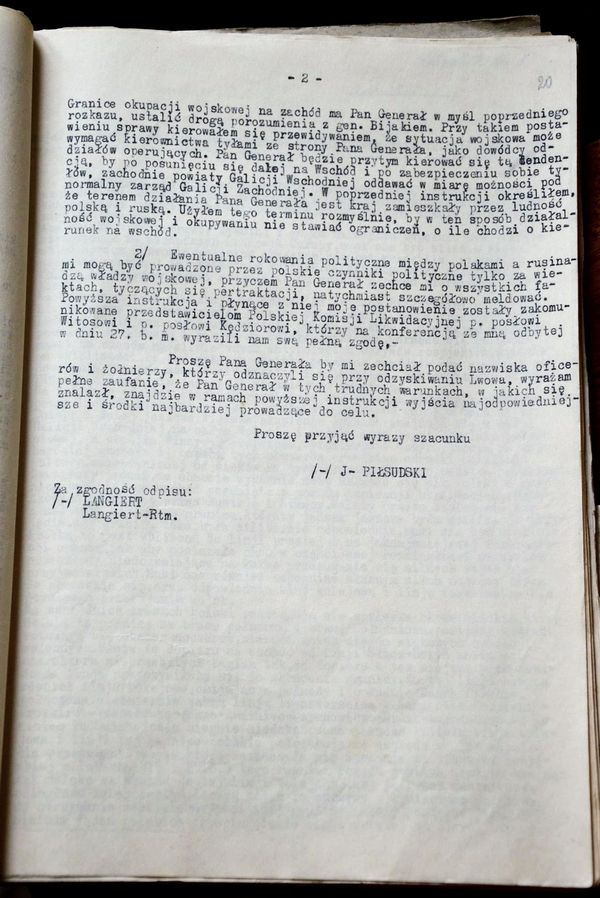
“Military occupation makes it possible, for the time being, not to resolve political matters that are currently ripe for final settlement.”

Then Piłsudski moves on to clarify what exactly must be done by General Rozwadowski in the occupied territories:
“The administration of the territory of Eastern Galicia, occupied by the Polish army, belongs to military authority. Civil authority, as an auxiliary body, is organized and approved by military authorities.

I am convinced that, knowing the situation in Eastern Galicia thoroughly, Your Excellency the General will be able to rely on Polish elements for civil authority and will introduce representatives of other nationalities into this administration only with the purpose of creating a favorable appearance for us.”

“In the previous instruction, I defined that the area of activity of Your Excellency the General is a land with Polish and Ukrainian populations. I use this term deliberately so as not to limit military activity and occupation toward the East.”
“Please provide me with the surnames of the officers and soldiers who distinguished themselves in the taking of Lviv.”
For today’s Polish politicians, these Piłsudski instructions raise a number of uncomfortable questions:
If there was no occupation, why does Piłsudski constantly use the phrase “military occupation”?
If there was no occupation of Lviv, why does Piłsudski ask for the names of the soldiers who distinguished themselves in the taking of Lviv?
If this was not occupation, why was authority transferred to military administration?
What political matters does military occupation “allow, for the time being, not to resolve”?
The current heads of Polish diplomacy and the Institute of National Remembrance avoid answering these questions.
The timeline of events fully undermines both the official position of the Polish Ministry of Foreign Affairs and the words of the head of the Institute of National Remembrance of Poland.
At the end of October 1918, competition begins between Ukrainians and Poles over who will proclaim their statehood faster on the ruins of the Austro-Hungarian Empire.
On October 16, 1918, Emperor Karl I issues a manifesto that proclaims the right to free self-determination for the creation of independent states by nations that made up the “patchwork empire” of the Habsburgs.
This manifesto echoes the “Fourteen Points” delivered by U.S. President Woodrow Wilson at the beginning of that same January.
Point 10 provided that “the peoples of Austria-Hungary, whose place among the nations we wish to see safeguarded and assured, should be given the freest opportunity for autonomous development.”
Regarding the future Polish state, Wilson stated:
“An independent Polish state should be created, which should include territories with an unquestionably Polish population…”
The problem was that a large part of the Polish elites wanted to include in an independent Poland lands inhabited by other peoples, in which Poles formed a minority—many areas of Lviv Oblast, Ternopil Oblast, the Subcarpathia region, and Volhynia did not have a prevailing Polish population.
For example, in the Lutsk county before the war—in 1911 there were almost 10% Poles. And this was the highest percentage across all of Volhynia. In all the other counties of Volhynia, there were even fewer Poles.
But in Lutsk itself there were hardly 10% Ukrainians. The cities of Galicia and Volhynia remained Polish and Jewish islands in the Ukrainian sea.
Therefore, the military occupation (as Piłsudski wrote) of these Ukrainian territories conflicted both with the Manifesto of Karl I and with Woodrow Wilson’s “Fourteen Points.”
Piłsudski understood this perfectly. That is precisely why he chose the path of accomplished facts—to place the international community before the fact: “Lviv—ours! Lutsk—ours!”
But he could not ignore these documents, because they created the legal framework and grounds for the legitimate creation of Polish independence:
“The manifesto of the former Kaiser Karl is recognized by Poland to the extent that on its basis the Polish Liquidation Commission was created…”
In other words, rejecting this manifesto was possible only at the cost of losing the legitimacy of the Liquidation Commission, which was one of the key tools for creating an independent Polish state in the autumn of 1918.
Yet the same manifesto was also a basis for the proclamation of the Ukrainian independent state, because it defined rights to self-determination for Ukrainians as well.
And Ukrainians fully made use of this opportunity. Two days after the imperial manifesto was announced, Ukrainian deputies of the Austrian parliament and of the Galician and Bukovynian regional sejms created the Ukrainian National Council.
On October 19, the Ukrainian National Council proclaims Ukrainian statehood—which today we remember as the West Ukrainian People’s Republic.
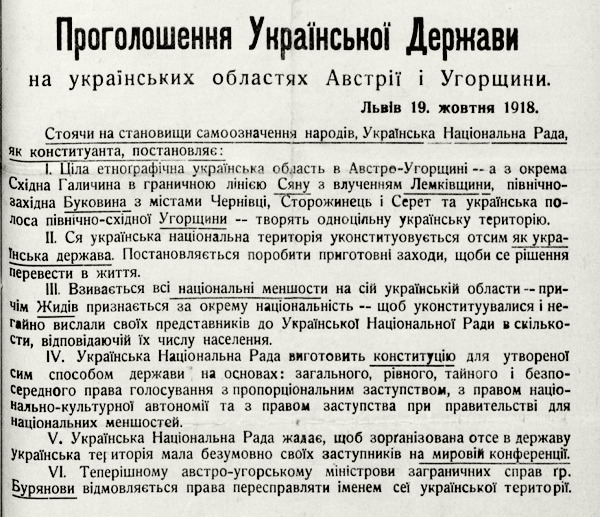
Ukrainians used the legal instruments for creating statehood from the ruins of the Austro-Hungarian Empire.
What remained for Piłsudski in those circumstances, who arrived in Warsaw only on November 10 after imprisonment in Germany?
Only the policy of accomplished facts: armed confrontation, and if successful—military occupation of the conquered lands, along with long negotiations with partners in the West to legitimize the occupation of Eastern Galicia and Western Volhynia.
Piłsudski writes this to Rozwadowski:
“Military occupation makes it possible, for the time being, not to resolve political matters that are currently ripening for final settlement.”
Translated into plain human language, this meant: we occupy these territories, and then we’ll see how quickly it becomes possible to negotiate with the international community.
Piłsudski understood perfectly well that these actions conflicted with the principles formulated both in Karl I’s manifesto and in Wilson’s “Fourteen Points.” He understood that the negotiating path is longer than the path of military occupation. And he ordered his generals to take the shorter route.
To legalize the annexation of Eastern Galicia and Western Volhynia, which were for the most part inhabited by Ukrainians, it took 5 years of fighting and negotiations.
Only in 1923 did a system of treaties finally come together, which legitimized the inclusion into Poland of territories conquered from and inhabited by Ukrainians. Moreover, Poland’s mandate in these territories was not unconditional: a number of conditions were specified there—conditions that, however, were never fulfilled by the Polish government.
Therefore, Poland’s Ministry of Foreign Affairs, to put it mildly, is being disingenuous in claiming that Poland NEVER occupied Ukraine.
Piłsudski’s actions laid the groundwork for new tension in the spiral of the Polish-Ukrainian conflict.
Interwar Poland did not become for Ukrainians a motherland. Poland became a stepmother for Ukrainians.
Ukrainians remembered this time precisely as a period of occupation. Ukrainians did not have equal access to education and participation in state administration. For many, it was a time of censorship, “the Bereza Kartuzka” camp and the “Sokal border,” armed “pacifications,” the destruction of Orthodox churches, colonization (“settlement”), and—in response to all these abuses of human rights—Ukrainian terrorism against the Polish state.
Politically, Bandera was brought about by Piłsudski.
During World War II, this conflict erupted in a horrifyingly bloody resolution.
The Volhynian massacre would never have happened if Poland had not occupied territories inhabited by Ukrainians in the autumn of 1918. This was a mistake for which both Poles and Ukrainians paid a terrible price. This does not justify the massacre, but it explains one of its causes.
The current political leadership of Poland has proven unable to critically reflect on its own history, unable to acknowledge mistakes.
Why?
The circles that shape Poland’s political agenda today paradoxically combine imperial paternalism toward the “younger brothers” with a victim complex—“Christ of the peoples.”
The victim complex implies a rejection of subjecthood—meaning responsibility for one’s own actions.
But imperialism is never passive. Imperialism is insistently paternalistic toward the “younger brothers.”
However, the history of a large part of Polish society today is the story of those who cannot decide whether Poland is a subject or an object in this history. Because this story is about the courage to take responsibility for one’s actions.
Piłsudski had that courage: he boldly made mistakes that later cost Poles and Ukrainians tens of thousands of human lives. But at least he took responsibility for himself when he ordered a military occupation of lands over which he had no right.
Today’s political leadership is more comfortable with the victim narrative: “Poland NEVER occupied Ukraine.”
But this way of thinking breaks all links between the causes and consequences of the events of the interwar two decades. Military occupation of lands that were 70–80% inhabited by Ukrainians who sought their own independent state could not help but create new tension between Poles and Ukrainians. The explosion in 1943–44 was only the result of decisions made in 1918–23.
That is, as soon as this part of Polish society abandons the victim paradigm and recognizes the responsibility of the reborn Polish state for decisions made in the past, recognizes the mistakes and their horrific cost—then the entire beautiful logic of the interwar “Arcadia” collapses.
This image has long been part of modern Polish identity, and identity is the answer to the question of who you are and who you are not. And suddenly it turns out that for someone, that beautiful “Arcadia” in those times looks more like the Maghreb under French colonial rule, and “Christ of the peoples” turns, in other people’s eyes, into “Pontius Pilate of the peoples.”
Such reflections are very painful. They are very hard to accept. That is why Ukrainians should understand the complexes of the people who today shape policy in Poland. It is very difficult to realize that you could be someone’s Pilate when you want to be someone’s Christ.
The head of Poland’s Institute of National Remembrance, in the already mentioned interview, says:
“I want to remind—Poland’s relations with the Ukrainian minority during the time of the independent Rzeczpospolita were not ideal… The Ukrainian population had its own rights. I only want to remind you what Ukrainians’ fates looked like behind the Soviet border. There was no Holodomor in Poland, there was no terror…”
From the perspective of Ukrainians in Galicia and Volhynia, these words sound something like: why are you upset—we oppressed you more gently than others.
That is why the key question arises: the armed confrontation between Poles and Ukrainians and the occupation of Ukrainian lands became one of the reasons why Ukraine lost its independence.
The Holodomor, the Great Terror, and “Bereza Kartuzka”—all of this resulted from the loss of Ukrainian independence.
The generation of Poles that fought for its independence won it in 1918, and then lost it in 1939, understood better why Poland ended up so weak in the face of external challenges.
The Polish state did not have the necessary internal strength. There was no necessary national unity: ideological, political, and class divisions within Polish society took their toll. But most of all, it’s hard to hope for unity if a large part of citizens feels like it is living under a foreign occupation. “A house divided against itself will not stand.”
But the generation of Polish independence and the generation of their sons had the courage to speak openly about the mistakes of interwar Poland—of course, those who had internal freedom from the victim complex.
For Ukrainians, this is another lesson: not only to recognize their mistakes that led to the loss of Ukrainian independence 100 years ago, but also to process their past in this way so that the wounds of that past do not dominate our consciousness.
The loss of Ukrainian independence cost us close to 16 million lives throughout the 20th century. And for many Ukrainians, the victim complex is also an excuse for today’s worst behavioral stereotypes. What is happening now with Polish society is a worrying signal to Ukrainians who are immersed in their own complexes: you don’t need enemies to cause yourself the greatest harm.
Earlier, among Poles there were giants like Jerzy Giedroyc and Jacek Kuroń. They did not parasitize on their fellow citizens’ victim complex. Now, among Polish politicians, there are no figures of that scale—no one who has the courage to tell Poles about Poland’s mistakes of the past.
Jacek Kuroń repeated many times that Poland, at least twice in the 20th century, stepped in the way of Ukrainian independence.
Poland won its independence at the price of Ukrainian independence.
It is time to say this out loud.
Published: November 8, 2018