






Events that took place on March 10–11, 1944, Ukrainians who lived in the Chełm region would remember as the darkest day of their lives. During these days, Polish units of the Home Army (Armia Krajowa), together with the so-called “Batalliony chłopskie” (Polish partisan forces made up mostly of local peasants), attacked the Ukrainian villages of Andriivka, Bereziv, Beresty, Vereshyn, Laskiv, Malychi, Malkiv, Modryń, Miagke, Riplin, Sahryn, Stryzhivets, Terebinets, Terebin, Turkovichі, and Shykhovychi—completely or partially burning them down. The Polish offensive did not end with those days and continued for several following weeks. According to sources, during this operation between 1,500 and 2,000 Ukrainians were killed. What then preceded these dreadful events? Vitalii Baka, employee of the Ukrainian Institute of National Remembrance, writes.

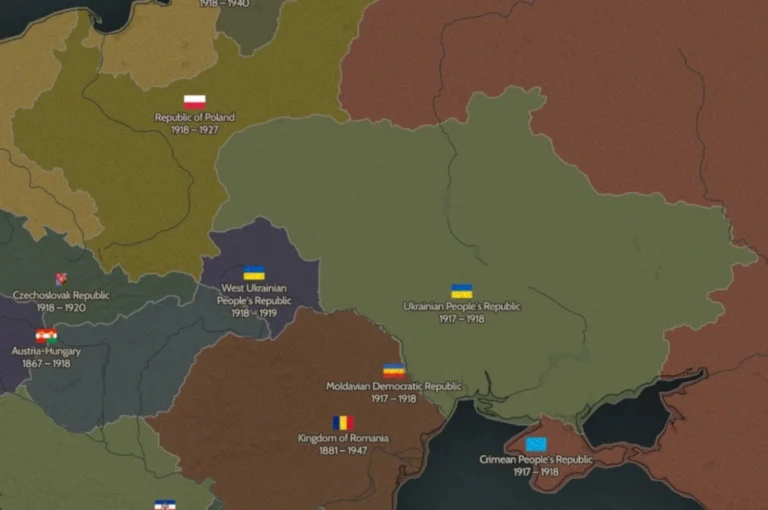
The ethnic map of Central and Eastern Europe in the interwar period was quite mixed; the borders of newly formed Central European states after the First World War rarely fully matched the boundaries of ethnic settlements. The multinational West Ukrainian territories were no exception—here, the main point of confrontation ran between Ukrainians and Poles. World War II again brought this ethnic issue to the forefront, adding to the volatile “cauldron” the question of the absence of a Ukrainian national state, and, for the Poles, the destruction of such a state as a result of German-Soviet aggression. The main actors in this struggle on the Ukrainian side were the Ukrainian Insurgent Army (UPA), and on the Polish side, the Home Army (AK). The conduct of brutal military actions only raised the temperature of the confrontation, in which human life began to be valued less and less. The first flare-up was in 1942—Volhynia; then the epicenters of the Ukrainian-Polish confrontation became Eastern Galicia, the Chełm region, Podlachia…
From the testimony protocol of Zina Malimon about the destruction of the village of Sahryn, April 26, 1944. On 9 March 1944, my whole family and I did not sleep all night. I saw how a Polish bandit group attacked Sahryn and shot with incendiary bullets. My mother, Olha, my sister Lida, my aunt Maria L., and I fled to the station/platform. On the way to the station, I was wounded in both legs. My mother took me in her arms and carried me onto the station. There were many people at the station. After some time, the bandits arrived and began beating on the doors and shouting, “Where is the police?” There was no police at the station. The bandits took the pigs from the station barns and left. A second group of bandits came up to the station and shouted for the doors to be opened to them. They threatened that they would place mines under the station. People started running up. Then the bandits began shooting at the upper area. They smashed the doors down below and rushed up. They beat all the men. While killing, they cursed. They took everything from above, and herded the women with children into the barn/yard, and then set it on fire from above. […] They also killed my mother Olha and my sister Lida. When my mother fell, my aunt fell too. The bandits thought they had also killed my aunt, but my aunt was not even wounded. After that they came to me; one of them shot at me. I was wounded in the head and fell. The bandit shot at me again and hit my arm. I lay there and moved not at all. The bandits thought I was dead and withdrew. My sister Lida was only wounded in the arm; she got up and wanted to run away. This time a bandit arrived and shot her in the head. My sister fell and died.
At the beginning of 1944, the Red Army begins an offensive operation in Volhynia, entering the lands of the interwar Second Polish Republic. This activates Polish underground nationalist forces, who decide to resolve the Ukrainian question radically in the Zakerzonnia territories, in particular in the Chełm region. A plan emerges for a special operation called “Operation Storm” (“Burza”). Home Army servicemen were to intensify their activity against the German army in order to seize these territories before the arrival of Soviet power and to demonstrate that they belonged to the Polish state. At the same time, military actions in the Chełm region were meant to weaken the potential territory where, in the future, a Ukrainian national movement might develop. As part of these processes, in March 1944, forces of the Polish underground carried out a large anti-Ukrainian operation, which is known in history as the “Hrubieszów revolution” (named after the city of Hrubieszów). The goal of this action was not the wholesale extermination of Ukrainians, but creating conditions under which they would leave these areas as quickly as possible. To achieve this, entire Ukrainian villages were burned, and the local population was killed in a demonstrative and brutal manner.
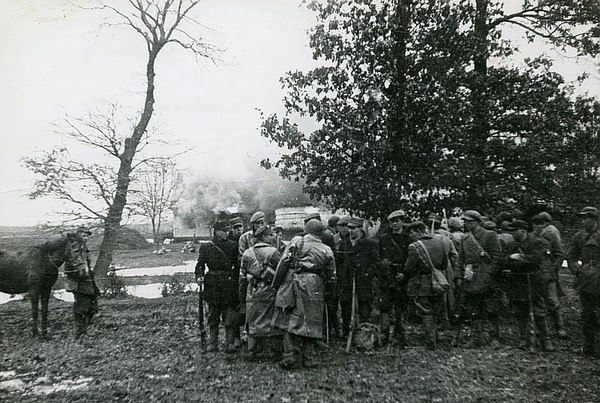
From the testimony protocol of Olha Shydlovska about the destruction of the village of Sahryn, April 26, 1944. On 10 March 1944, early, around 4 o’clock, I saw that the village was burning and there was heavy firing with incendiary bullets. I gathered my children—Sofia, age 9; Maria, age 3; Anna, age 6—and my elderly father, age 69, and hid in an almost completely destroyed cellar/bunker. From the cellar, you could see what was happening all around us. I saw how Polish bandits searched for hiding places, saying, “We have to look—because someone might be hit here.” I also saw and heard how the bandits attacked my neighbor, Maria Nosal. They killed her by firing three shots into her. They wanted to throw Maria Nosal into the fire as well, but one of them said that she would burn even so. Maria Nosal’s child, Evfrozyna, age 7, hearing that her mother had already been killed, began to scream terribly. They had already got into the hiding place. The bandits approached the hiding place and ordered those inside to come out, cursing. Three people came out: Antonina Tymoschuk, Evstakhii Tymoschuk, and Lida Tymoschuk. The bandits shot them all. Later their corpses burned, and the remaining pigs were dragged away. […] From the cellar I heard the gang killing people. I heard a 6-year-old boy begging that they kill him, because his mother had already been killed. He said, “My mother doesn’t live and I don’t want to live.”
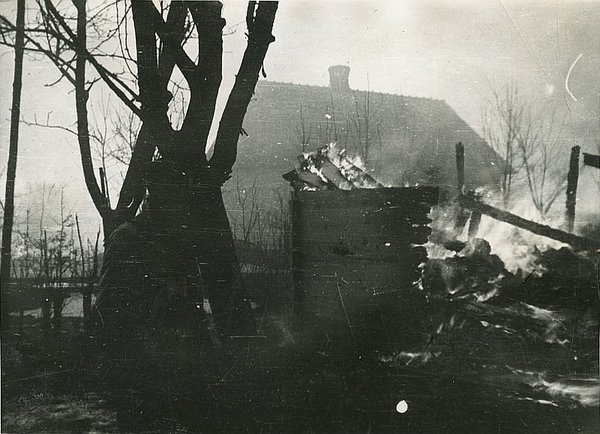
The bloody climax of the “Hrubieszów revolution” were the events in Sahryn. The Ukrainian village of Sahryn (today the gmina of Werbkowice, within Hrubieszów County, Lublin Voivodeship, the Republic of Poland) was completely burned down by the Poles on March 10, 1944. According to sources, during the destruction of this village by Polish troops, between 800 and 1,240 Ukrainians were killed and tortured. Among them, most were women and children. Before death, the victims suffered merciless abuse and torture. The large number of victims in Sahrin is explained by the fact that every evening a lot of people from neighboring villages gathered in Sahrin to spend the night under the protection of Ukrainian police and the local self-defense forces stationed there. In the village, the church was destroyed, parish buildings were destroyed, over 260 residential houses were burned, the prayer house of the Evangelical Christians community was destroyed, and hundreds of farm/outbuilding structures were destroyed.
Horrifying pictures of that day emerge from history thanks to testimony protocols—recorded on the spot shortly after the events from the words of eyewitnesses from Sahryn who managed to survive. There were only a few of them—those who managed to hide from enemy bullets in shelters or who received non-fatal wounds and pretended to be dead. The drama of the situation was intensified by the fact that local Polish children helped search for the hiding places.
From the testimony protocol of Olha Shydlovska about the destruction of the village of Sahryn, April 26, 1944. The gang had local guides. This party of bandits, numbering 7, had as its guides 2 small Polish boys—one 14 and the other 12. I heard how the gang promised those boys good pay, only if they showed them hiding places. Both boys were Poles who were raised by Yatsiuk, the owner—a Ukrainian. […] These boys also showed the hiding place of Stelmaschuk, from which the bandits dragged out 9 people and killed them. There were still people in the shelter, but somehow they did not finish them off. The small boys led the bandits through the whole village and showed the hiding places.